The Sovereign Vault
Private, Permanent Safekeeping for Your Certification
A Technical Provenance™ Certification documents what a piece of art is and carries. The Sovereign Vault ensures that record is never lost.
Every certification is archived in a private, secured repository — accessible only to you, the certificate holder, for as long as your Vault subscription remains active. It is not a public ledger and not a marketing claim. It is a safeguard: a permanent home for the record you paid to have created, protected from the ordinary risks of lost files, damaged drives, or a folder misplaced years from now.
For collectors who understand that a serious record is worth protecting, the Vault is the quiet infrastructure behind that protection.
Technical Provenance™ is Transmuting ART’s discipline for documenting, evaluating, and clarifying a work beyond surface appearance. It was developed from a technical mindset shaped by advanced laser systems, patent-based invention, and the discipline of understanding how invisible forces create visible outcomes.
The Questions It Asks
At its core, Technical Provenance™ asks a different set of questions than traditional aesthetic review. Instead of stopping at whether a piece is beautiful, desirable, or visually compatible, it examines what can be documented, what can be interpreted with discipline, and what the work is actually doing within the environment in which it appears.
What the Process Looks Like
This process may include source review, authorship context, interpretive analysis, metadata organization, environmental relevance, and the identification of gaps, risks, or inconsistencies that deserve closer attention. In some cases, the work functions as a focused desktop review; in others, it becomes a more developed documentation package built to support confidence, decision-making, and long-term record integrity.
Technical Provenance™ is not intended to imitate museum-grade authentication or courtroom-level forensic attribution. It is designed as a practical, disciplined framework for clients who need greater clarity, stronger traceability, and a more organized understanding of an artwork’s technical, contextual, and interpretive dimensions.
Why It Matters
Within Transmuting ART, this offering also serves a broader purpose. It helps bridge the space between artistic experience and documented reasoning, giving collectors, designers, and advisors a way to engage art with more precision, more confidence, and more usable insight.
For bespoke engagements, Technical Provenance™ can also function as part of a premium package in which the artwork itself is paired with expanded certification and supporting documentation. In that role, it becomes not a simple add-on, but a value-multiplying component of the work as a whole.
“What impressed me most was how the reading connected the artwork to the room around it. As an interior designer, I naturally evaluate color, scale, lighting, placement, and emotional impact, and the analysis touched on all of those layers in a thoughtful way. It made me consider the piece less as an isolated work of art and more as an active part of the spatial experience.”
— Melonie Madzel, Founder & Principal Designer, Linen & Earth Interior Design
Forgery and Risk Indicators
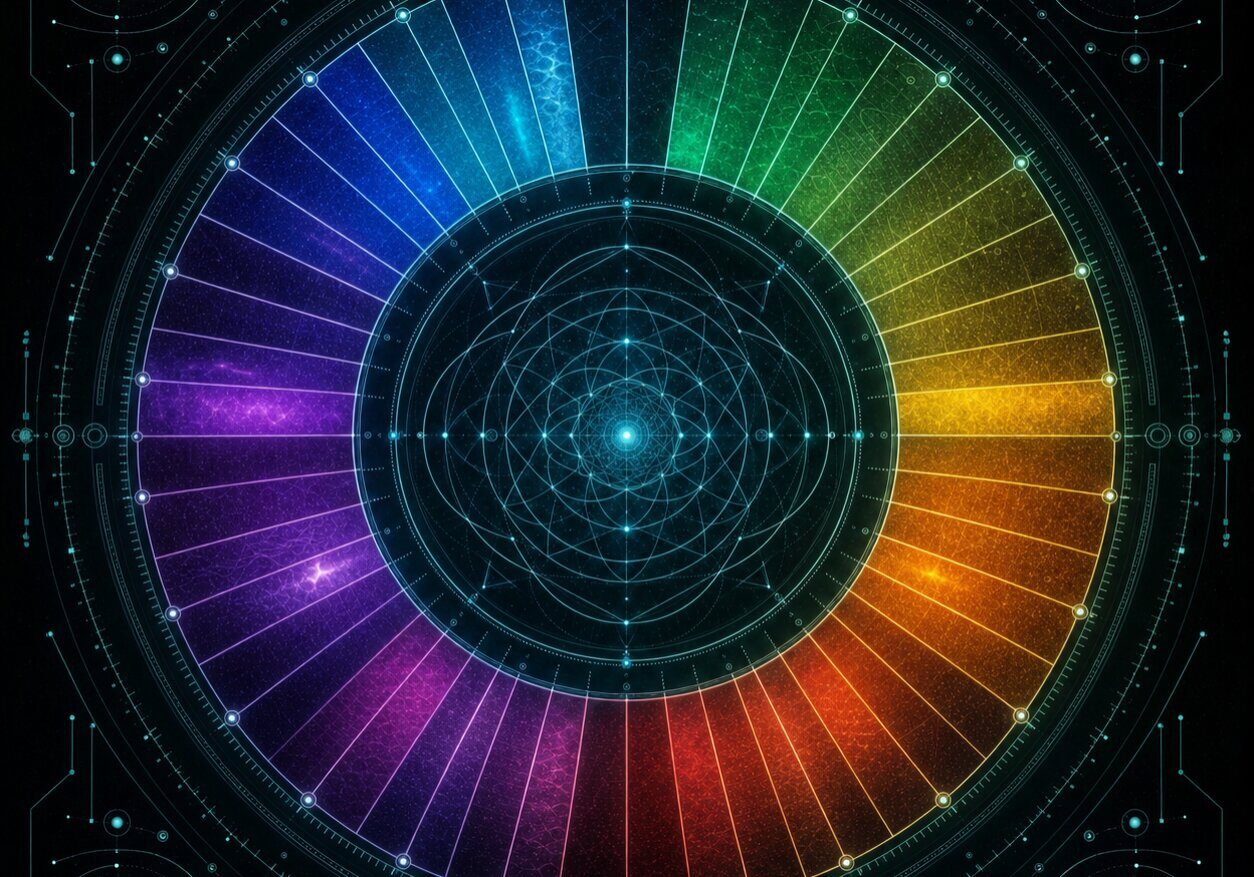
A sophisticated forger can replicate what the eye sees—the composition, the colors, even the apparent aging of the surface. What is far harder to replicate is the invisible structure of the original work: the chromatic relationships it broadcasts, the sacred geometry embedded in the artist’s hand, and the broader energetic field it appears to govern. These can be read as documented indicators, specific to that piece, giving you a way to compare an original against later impressions or reproductions.
At the moment of certification, Technical Provenance™ creates a permanent, timestamped record of the artwork’s energetic intelligence—chromatic spectral signature, sacred geometry, archetypal resonance, Solfeggio harmonic correspondence, and more—assigned a unique Asset ID linked to that specific work.
In practice, a forgery or reproduction may approximate the visible image while still diverging from this documented baseline. Its chromatic relationships may shift, its geometry may distort, and its energetic broadcast may not align. Technical Provenance™ is designed to surface those differences—things the untrained eye was never taught to catch.
Technical Provenance™ does not replace traditional physical authentication. It adds a complementary forensic layer that physical methods alone do not address, giving collectors and advisors a broader, more disciplined framework for assessing risk.
For clients, this means you gain another structured way to compare works, understand risk, and make more confident decisions about what you choose to acquire, keep, or present.
Sample “Technical Provenance” to Experience!

Melonie Madzel, Founder & Principal Designer, Linen & Earth Interior Design